Idle Machinery: Auditing Cargo Flow Before Automating a Port-Centric Warehouse
The automation proposal arrives with a slide showing throughput per hour, a headcount reduction figure and a payback period expressed in months. It rarely arrives with a histogram of actual dwell times at that facility. For a port-centric warehouse, that omission is usually where the money goes missing.
Port-centric logistics has a particular rhythm. Goods arrive on a vessel schedule that is not the site's to control, sit for a dwell period measured in hours or days rather than weeks, and leave on a trailer that may or may not have been booked. Automation, by contrast, is designed around predictability. Where the two meet without a proper reading of the flow, the result is expensive equipment running at a fraction of its rated capacity while the site continues to staff flexibly around the surges.
The Assumption That Does the Damage
Most vendor models take an annual volume and divide it by available hours. That arithmetic produces a smooth line. Real operations do not look like a smooth line. They look like a quiet Tuesday followed by a Friday where three vessels land within fourteen hours and the yard becomes a queue.
A warehouse that is busy 40% of the time and overwhelmed 10% of the time does not need robots operating at a constant rate. It needs variable capacity, accurate advance information and a yard that can absorb a spike. Those are operational fixes, and they are far cheaper than a fixed-capacity installation that cannot decelerate.
The relevant question is not 'could this facility be automated?' but 'what fraction of the work is repetitive enough, predictable enough and stable enough to justify a machine doing it?' That is a measurement problem, and it can be answered in weeks.
Map Velocity, Not Square Metres
A flow audit begins by classifying stock by movement rather than by storage type. Take twelve months of WMS and TMS data and segment every SKU or consignment by receipts per month, order frequency and unit velocity. The output is usually uncomfortable: a long tail of slow-moving lines occupying the best-positioned locations, while the fast movers are scattered wherever space was free at the time of putaway.
In a port-centric facility, add a second dimension that inland warehouses rarely track — the inbound container or vessel reference. Lines that arrive together and leave together behave differently from lines that arrive in the same container but disperse over a fortnight. Cross-docking potential hides in that second category, and automation often destroys it by forcing everything through a putaway step that was never necessary.
Re-slotting on the back of this analysis frequently delivers double-digit percentage gains in pick productivity with no capital expenditure at all. It is worth doing first, because automation built on a poorly slotted layout simply automates the inefficiency.
Peak Surges and the Port Calendar
Dwell-time distribution matters more than average dwell. Plot the distribution rather than the mean, and then overlay vessel schedules, cut-off dates for sailings, seasonal retail peaks and any known congestion at the port of arrival. The resulting picture shows whether peaks are predictable — driven by schedule — or random.
Predictable peaks can be engineered for, with booked labour, pre-staged trailers and pre-agreed overflow capacity. Random peaks cannot be automated away; they need slack. A site that has never quantified the difference will generally overestimate what fixed automation can do for it.
Cross-Docking Friction Points
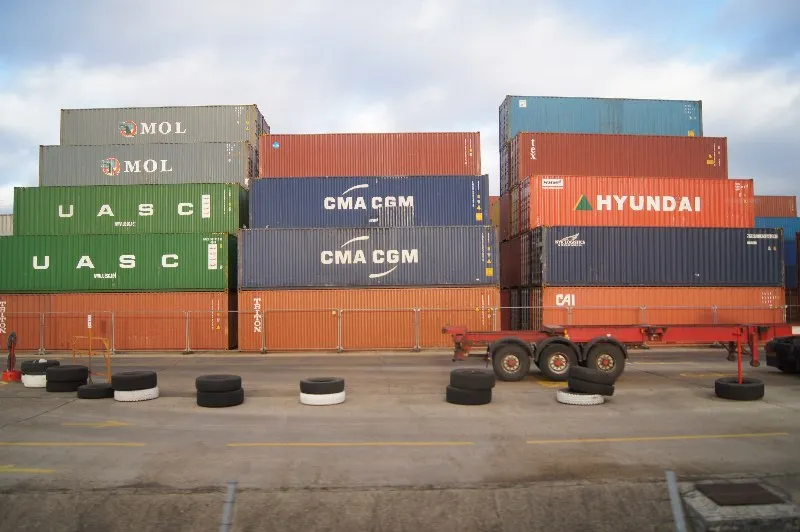
The most under-analysed area in port-centric warehouses is the interface between gate, yard and dock. Time-stamp the whole cycle for a sample of movements: trailer arrival, gate-in, yard position, dock assignment, start of discharge, completion, gate-out. The gaps between those timestamps are where the operational cost actually lives.
Common findings include arrival variance that defeats any fixed dock schedule, advance shipping notices that arrive with the vehicle or not at all, pallet labelling that requires rework at the dock face, and booking windows so wide that the yard absorbs the difference. Each of these undermines automation, because a robot cannot compensate for an inaccurate ASN or a mislabelled pallet. Fixing the data quality upstream often removes the labour problem the automation was meant to solve.
When Automation Genuinely Pays
This is not an argument against automation. It is an argument for sequencing. Automation tends to perform well where several conditions hold simultaneously: volume is stable within a narrow band, SKU velocity is concentrated in a small number of lines, inbound data is accurate and timely, dwell time is long enough to justify putaway, and the operation runs across multiple shifts.
Where those conditions are partly present, semi-automation — goods-to-person stations, automated labelling, conveyorised sortation on a defined lane — usually outperforms a full installation, because it can be scaled back when the flow changes.
Where volumes are modest, variable and dominated by cross-docking, the honest conclusion is often that the site should invest in visibility and yard management instead. That is a less impressive recommendation to take to a board, but it is the one the data supports.
Scoping the Flow Audit
A credible audit takes six to ten weeks and needs three inputs: transactional data from the WMS and TMS, timestamped observations from the yard and dock, and structured conversations with the people who schedule labour. Sampling is acceptable if it covers a full trading cycle including at least one peak.
The deliverables should be specific: a velocity segmentation, a dwell-time distribution, a peak calendar with confidence intervals, a cross-dock friction map and a shortlist of interventions ranked by cost per unit of flow improvement. Automation should appear on that list if — and only if — the data places it there.
A Question Worth Asking Early
The test for any automation proposal is simple. Ask what proportion of the modelled throughput depends on volumes the site has never actually sustained for a full quarter. If the answer is a large one, the business case is a forecast rather than a measurement. In a port-centric environment, where arrivals are set by carriers and clearances, measuring the flow first is not caution. It is the only way to avoid buying capacity that sits still while the site continues to solve its real problems with labour, layout and information.